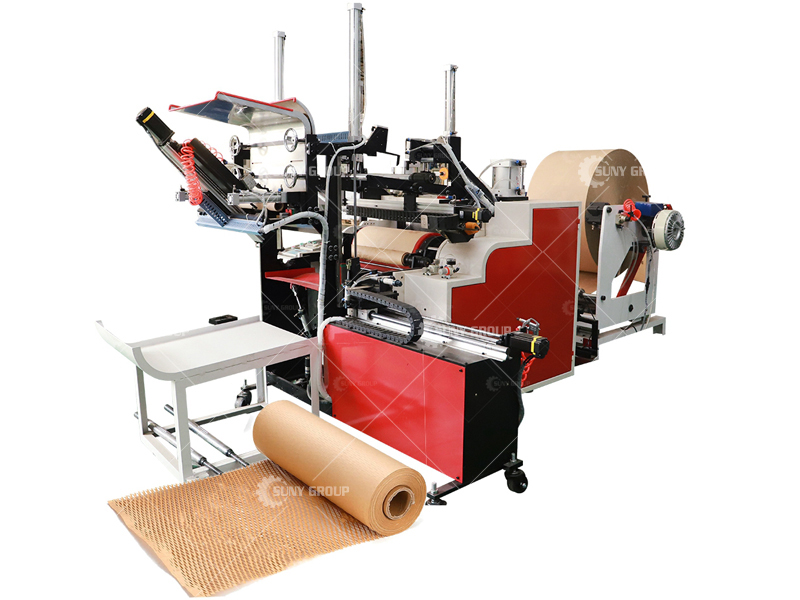
Fully Automatic Honeycomb Wrapping Paper Machine
As businesses increasingly look for sustainable alternatives to plastic packaging, honeycomb paper has become an attractive protective packaging material, creating growing demand for the fully automatic honeycomb wrapping paper machine. Its unique three-dimensional honeycomb structure provides excellent cushioning, flexibility, lightweight performance, and good load distribution. Produced efficiently by an fully automatic honeycomb wrapping paper machine, honeycomb paper can be widely used for wrapping, void filling, corner protection, furniture packaging, e-commerce shipping, and fragile product protection. With high production efficiency and consistent output, the automatic honeycomb paper machine provides an efficient solution for manufacturers and businesses looking to produce sustainable protective packaging at scale.
The main advantages of honeycomb paper include:
- Excellent cushioning performance – The expanded cells absorb and distribute impact forces.
- Lightweight structure – It provides protection without adding excessive packaging weight.
- Paper-based and recyclable – It can help companies reduce dependence on plastic packaging.
- Flexible application – It can wrap products with different shapes and fill empty spaces inside cartons.
- Space-saving storage – The material is stored as compact rolls before expansion.
- Wide application range – It is suitable for e-commerce, logistics, furniture, electronics, ceramics, glassware, and industrial products.
What Is an Automatic Honeycomb Paper Machine?
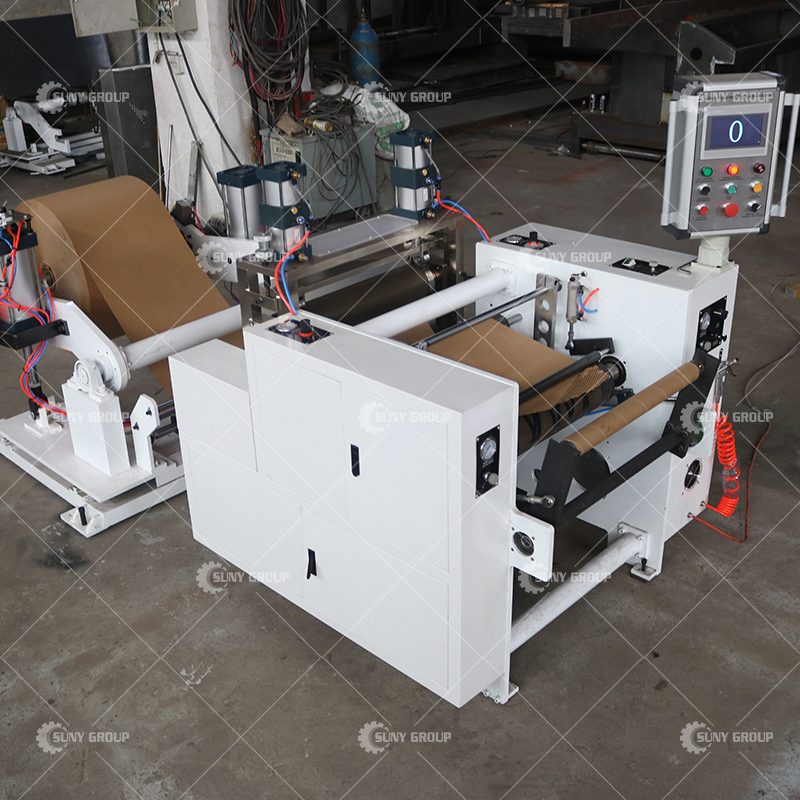
An fully automatic honeycomb wrapping paper machine is an automated packaging equipment system designed to continuously convert kraft paper into expandable honeycomb packaging material.
Depending on the machine configuration, the production process can include automatic paper feeding, tension control, slitting or perforating, forming, stretching, cutting, and rewinding. Modern automatic machines can also provide adjustable speed and tension control to maintain stable production.
The basic production process can be summarized as:
Kraft Paper Roll → Automatic Feeding → Slitting/Perforating → Stretching → Honeycomb Forming → Cutting → Rewinding/Dispensing
The resulting honeycomb paper expands into a three-dimensional structure that can be used directly for protective packaging.
Advantages of an Automatic Honeycomb Paper Machine
The biggest difference between an automatic honeycomb paper machine and traditional equipment is automation and production efficiency.
1. Higher Production Efficiency
Automatic feeding, forming, cutting, and rewinding reduce manual intervention. This makes the machine suitable for continuous packaging operations and high-volume production.
2. Lower Labor Requirements
Traditional honeycomb paper equipment may require operators to manually control feeding, pulling, cutting, or other processes. An automatic system integrates these operations, allowing fewer workers to manage the production process.
3. More Consistent Product Quality
Automatic tension control and speed regulation help maintain uniform honeycomb expansion and product dimensions. Stable operation is particularly important for companies producing packaging materials for large customers.
4. Flexible Production
A good automatic honeycomb paper making machine should allow users to adjust production parameters according to paper width, paper thickness, honeycomb size, and packaging requirements.
5. Better Integration With Packaging Operations
For e-commerce warehouses, fulfillment centers, and large packaging factories, automatic dispensing and cutting can reduce repetitive manual work and make packing stations more efficient.
Automatic Honeycomb Paper Machine vs. Ordinary Honeycomb Paper Machine
Although both machines produce honeycomb paper, their working methods and production efficiency can be significantly different.
| Feature | Ordinary Honeycomb Paper Machine | Automatic Honeycomb Paper Machine |
|---|---|---|
| Paper feeding | Manual or semi-automatic | Automatic |
| Tension control | Basic/manual | Automatic |
| Production speed | Relatively lower | Higher |
| Cutting | Manual/semi-automatic | Automatic or synchronized |
| Operation | More operator involvement | Reduced manual operation |
| Product consistency | Depends more on operator | More stable |
| Labor cost | Higher | Lower |
| Suitable production volume | Small/medium | Medium/high volume |
In a conventional machine, operators may need to participate in feeding, adjustment, cutting, and material handling. In an automatic honeycomb paper machine, these processes can be integrated into a continuous production system.
Therefore, automation does not fundamentally change the principle of creating honeycomb cells; instead, it automates and synchronizes the individual production steps, improving efficiency, consistency, and ease of operation.
Who Should Choose an Automatic Honeycomb Paper Machine?
An automatic model is especially suitable for users with stable and relatively high packaging demand.
E-commerce Companies
Online retailers may need to package hundreds or thousands of products every day. Automatic dispensing and cutting can improve packing efficiency and reduce repetitive manual operations.
Packaging Material Manufacturers
If you plan to manufacture honeycomb paper as a commercial packaging product, an automatic machine is more suitable for continuous production and standardized output.
Furniture Manufacturers
Furniture and interior products often require corner protection, surface protection, and void filling. Honeycomb packaging can provide lightweight structural protection for these applications.
Logistics and Fulfillment Centers
Large warehouses can benefit from automatic paper dispensing because packaging speed is closely related to overall order-processing efficiency.
Electronics, Glass and Ceramics Companies
Fragile products need protection against scratches, vibration, and impact. Honeycomb paper can be used as a protective wrapping and cushioning material.
How to Choose the Right Automatic Honeycomb Paper Machine?
Before purchasing an automatic honeycomb paper machine, buyers should evaluate the following factors:
- Production capacity – Select a machine according to daily or monthly packaging demand.
- Paper width – Confirm that the machine supports your required kraft paper width.
- Paper thickness and GSM – Different packaging applications require different paper specifications.
- Honeycomb cell size – Choose the appropriate cell structure according to cushioning and protection requirements.
- Speed adjustment – Variable-speed control provides greater production flexibility.
- Tension control – Stable tension is important for uniform honeycomb expansion.
- Automatic cutting system – Automatic length control can reduce material waste and manual work.
- Control system – PLC or intelligent control systems can simplify operation and parameter adjustment.
- Machine stability – Check the quality of motors, transmission components, sensors, blades, and other critical parts.
- After-sales service – Choose a manufacturer that can provide installation guidance, spare parts, technical support, and operator training.
The automatic honeycomb paper machine is an efficient solution for producing modern paper-based protective packaging. Honeycomb paper combines lightweight construction, cushioning performance, flexible applications, and recyclability, making it increasingly attractive as companies seek alternatives to plastic-based packaging.
For small businesses with limited production requirements, a simple or semi-automatic machine may be sufficient. However, for packaging manufacturers, e-commerce companies, logistics centers, furniture factories, and other businesses with high-volume demand, an automatic honeycomb paper machine can provide higher productivity, lower labor requirements, better consistency, and easier production management.
When selecting a machine, buyers should not focus only on maximum speed. Production capacity, paper specifications, automation level, tension control, cutting accuracy, product quality, machine stability, and after-sales service should all be considered to ensure the equipment matches the actual packaging application.